ESA’s Hera mission is in the month scheduled for its major braking sequence before reaching the Didymos asteroid system. The agency’s 7 October operational preview set out burns on 15 and 22 October. This article explains that published plan; it does not independently confirm that each manoeuvre has been completed. [1]
A November rendezvous remains the reference
The current mission page lists November 2026 for rendezvous with the binary asteroid system. Braking in October and rendezvous in November are different stages, not contradictory arrival claims. Hera launched on 7 October 2024 and will investigate Dimorphos, the smaller of the two bodies. [2]
Why slowing down is an operation in itself
ESA planned a 93-minute initial burn and a second burn of about 31 minutes on 22 October, followed by smaller adjustments. Engineers use telemetry and tracking to compare the actual velocity change with the intended one. Issuing a command and verifying its outcome are separate steps. [1]
What DART already demonstrated
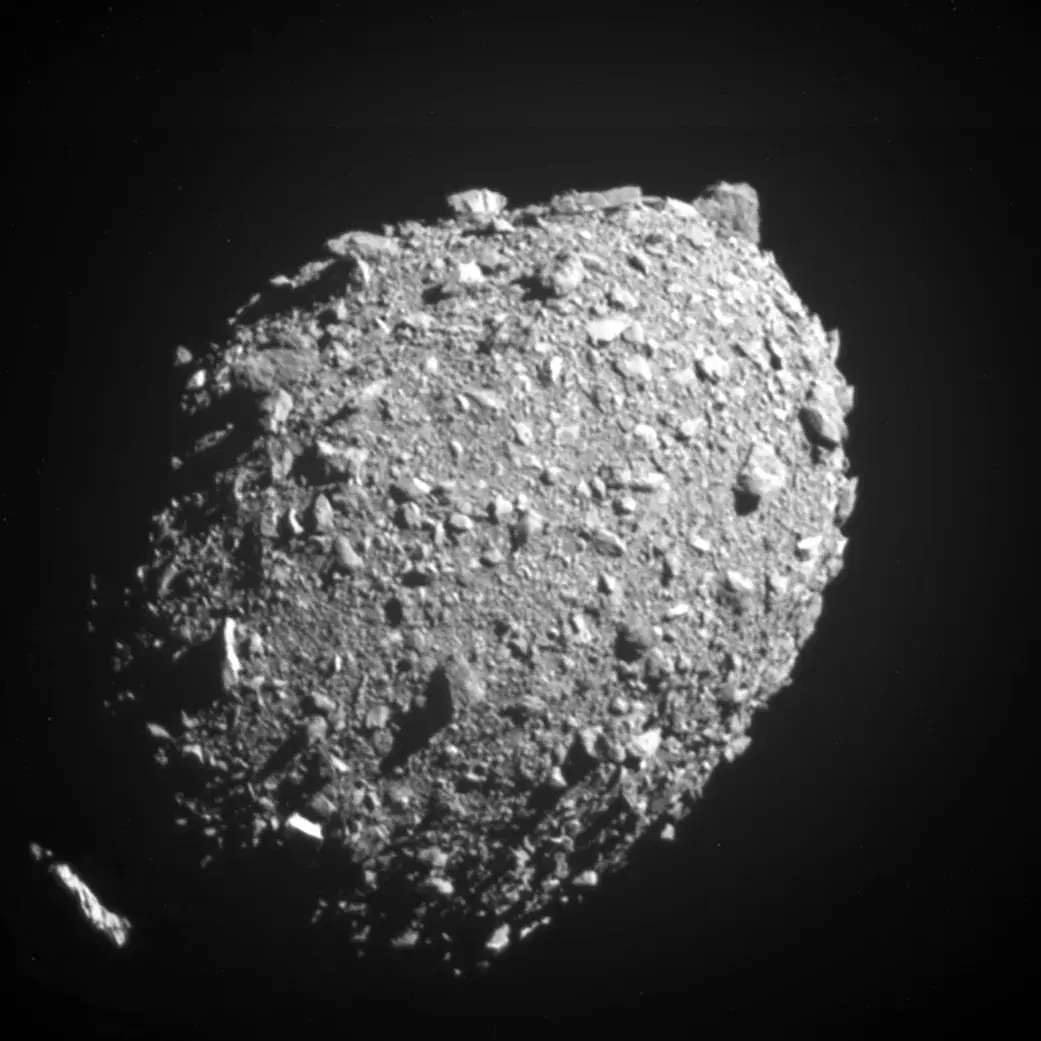
NASA’s DART hit Dimorphos on 26 September 2022. ESA’s first published assessment reported a roughly 32-minute shortening of its orbit around Didymos, with continuing measurements. That demonstrated deflection in a test system; the image accompanying this article is from DART’s approach in 2022, not a new Hera photograph. [5]
What Hera still needs to measure
The scientific task includes studying the asteroid’s mass, structure and altered surface. These measurements help researchers understand why the impact transferred momentum as it did. A measured orbit change is evidence of an effect, but it does not by itself explain the material properties that produced it. [3]
Two small spacecraft add different perspectives
Hera carries Milani and Juventas. Milani is designed to investigate surface composition and dust; Juventas will use radar to investigate the interior. Their planned close operations also test communications and navigation in exceptionally weak gravity. [4]
What comes next
The next useful updates are confirmed manoeuvre results and the rendezvous sequence. The mission’s purpose is planetary-defence research; the published approach plan is not an announcement that these asteroids are threatening Earth.