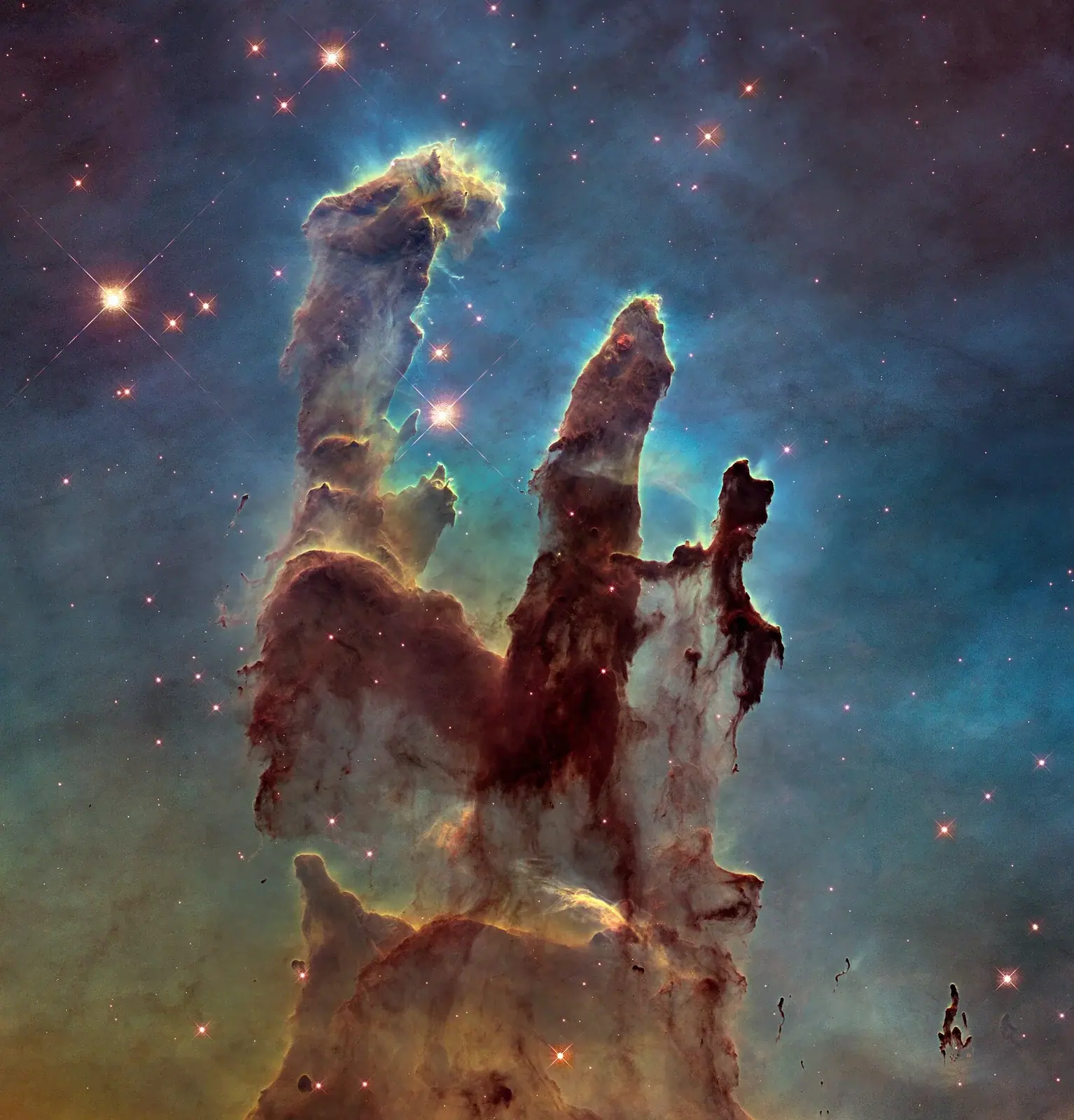
NASA’s Astronomy Picture of the Day for 18 October features the Eagle Nebula’s Pillars of Creation through sonification: a presentation of observations as sound. [1]
What the listener is hearing
NASA’s explanation describes a left-to-right scan combining visible-light and X-ray observations, with vertical position determining pitch. This is data interpretation, rather than a microphone recording from beside the pillars. [1]
How the mapping works
The Chandra project’s M16 page explains that the optical and X-ray components can be heard separately or together. A horizontal scan translates features into audio, with the pillars’ structure producing changes in pitch. This is a designed correspondence between data and sound: different choices of mapping would create a different listening experience. The method can preserve meaningful relationships without implying that the objects emit those musical notes as audible sound travelling to Earth. [2]
A project with an earlier history
Chandra’s September 2020 sonification collection described converting astronomical images into sound, including the Galactic Center, Cassiopeia A and the Pillars of Creation. That history matters when dating today’s item. An established project can be selected for a new daily feature without being a new measurement, mission or first release of the underlying technique. The publication date and the observation date answer different questions and should remain visible to readers. [3]
A different route into astronomical information
NASA’s Hubble sonification collection offers multiple examples in which image properties are represented through sound. The attraction is a second way of exploring information normally delivered visually. For a reader or listener, it is useful to ask which observable controls pitch, volume or timing, and which choices come from the presentation. Listening alongside the explanation makes the data relationship clearer than describing the result as simply the sound of space. [4]
What comes next
Explore the official NASA feature and its linked video to compare the image with the sound. Nove’s assessment: the value is in making data perceptible in another form, with the mapping explained. The archive Hubble photograph accompanying this article is a visible-light observation from 2014, not a new exposure captured for the 18 October feature.